PERSONAL ACCOUNTS BY MEMBERS OF QUEEN ALEXANDRA'S IMPERIAL MILITARY NURSING SERVICE and TERRITORIAL ARMY NURSING SERVICE

***

CROWN COPYRIGHT:  THE NATIONAL ARCHIVES WO222/189, Item 1a

Nursing in the British Army
Peacetime 1938
Queen Alexandra’s Imperial Military Nursing Service in 1938

     It will be quite unnecessary to begin this short article on Nursing in Queen Alexandra’s Imperial Military Nursing Service with an account of the life and work of Florence Nightingale. She is known and recognised as the pioneer of all nursing in the Army throughout the world. But I think a few dates may interest readers. It was in 1854 that those first 40 nurses went out to the Crimea to do what they could to relieve the sufferings of the wounded and sick soldiers at the base hospitals in the war area. From that beginning sprang the Army Nursing Service of the Great War, when fully qualified trained nurses served in Base Hospitals, Stationary Hospitals, Casualty Clearing Stations and advanced Operating Centres in every war area from 1914 to 1918.

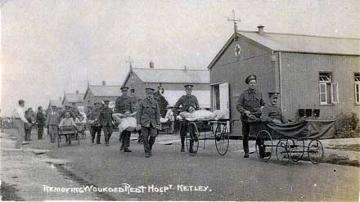
      It was to Chatham that the wounded from the Crimea were brought and this was the first hospital to have Sisters on its staff, and during the next few years they began working in Military Hospitals in London, at Netley, and at Woolwich, but it was not until 1881 that the Army Nursing Service was inaugurated, and in 1883 it was published in Army Orders that Sisters were to be employed in all Army Hospitals with 100 or more beds. The next year, 1884, a code of Regulations for the “Female Nursing Service” was drawn up and issued to all concerned. The other hospitals which then needed to be staffed were Aldershot, Gosport, Portsmouth, Devonport, Dover, Shorncliffe, Canterbury, Curragh (Ireland), Malta and Gibraltar. So this date marks the beginning of the overseas work of Sisters in Military Hospitals in peacetime – fifty-five years ago, and the date of the first large increase in the establishment of Army Sisters.

      By this time it seems to have been generally recognised that the “Female Nursing Service” was of great use in the Army, and this was proved again during the War in South Africa, when with the Reserves (The Reserve Service having come into being in 1897) a total of 1,400 nurses were sent to South Africa - of these 80 were supplied by Canada, Australia and New Zealand. When this war was over, records show that in an address given by the Director General, recommending the formation of Queen Alexandra's Imperial Military Nursing Service, he concluded with these words:

     “We believe that an extension of powers of the Matron, of the Sisters and the Nurses in Military Hospitals, will be of enormous advantage to the Officer-in-Charge of the Hospital; through him to the General Officer Commanding, and ultimately to the Army at large”.

     In 1902, Queen Alexandra's Imperial Military Nursing Service came into being. Queen Alexandra took a personal and very real interest in its formation, and it is largely due to her help that the Service was founded on a firm basis, and that recognition was given to it from then onwards, as an integral part of His Majesty’s Regular Forces.
In 1913, the Q.A.I.M.N.S. Reserve Service was in existence, so that when the Great War of 1914 broke out, the Nursing Service was to a certain extent, prepared for emergency, though no one realised what it would be called upon to carry out in the next four years.

     In 1914, the Service was only about 300 strong, but during 1914 no less than 2,223 trained nurses were enrolled into the Reserve, and of those 1,803 were sent abroad. Increasing year by year, the Service and its Reserve ended in 1919 with a membership of 10,404 fully trained nurses. To this total must be added the V.A.Ds supplied by the Order of St. John of Jerusalem, and the British Red Cross Society, 8,495 of whom took the place of the R.A.M.C. orderlies in Military Hospitals. The total number of trained nurses and V.A.Ds who were sent abroad to war areas was 11,483. It must be pointed out that these figures are solely those of Queen Alexandra's Imperial Military Nursing Service – our colleagues in Queen Alexandra’s Royal Naval Nursing Service, and the Territorial Force Nursing Service have their own tale to tell of service in wartime and organized nursing in time of peace. Princess Mary’s Royal Air Force Nursing Service came into existence after the Great War.

     I think the fact that speaks volumes for the Nursing Service itself as well as for those who administered it, is that of the casualties, only 36 were actually killed or drowned through enemy action, and in all the total number of deaths was 195. When one remembers the countries, climates, and the conditions under which these women lived and worked in heat and cold, we must all agree that the women of England of that day must all have been in A.1. Class, and must have known how to live and keep fit under all conditions. Dame Ethel Hope Becher, G.B.E., R.R.C., Chevalier of the Legion of Honour, was the Matron-in-Chief throughout the War, and in each Eastern War Area there was a Principal Matron, responsible to Headquarters. These few heads of the Army Nursing Service should go down in history as women whose work in the organization of this branch of women’s service in wartime was such as would have been thought beyond the bounds of human possibility a few years before. The work of organization carried out in France by the Matron-in-Chief, British Expeditionary Force, Dame Maud McCarthy, G.B.E., R.R.C., was prodigious.

     Then came the demobilisation of the Reserve, and Queen Alexandra's Imperial Military Nursing Service settled down again to its peacetime nursing, and as a general rule, this is routine nursing as in any other hospital, i.e. nursing the patients and teaching the nurses in training. In Military Hospitals these latter are, of course, the R.A.M.C. nursing orderlies, who do their training in much the same way as the nurses in any civilian hospital, with practical experience in surgical and medical wards and regular lectures year by year and examinations at the end of each completed course of lectures. The best of these men are trained up to the “Trained Nurse” standard and are encouraged to take their Civilian State Registered Male Nurse examination.

     If I am to tell you of the Service as it is today, I must hurry over the next few years, to 1926, which brings us to the amalgamation of the Q.A.I.M.N.S. with Queen Alexandra’s Military Nursing Service for India. Until this year the R.A.M.C. Medical Officers had served in India, but the two Nursing Services were quite separate. In 1927, the Queen Alexandra’s Military Families’ Nursing Service was absorbed into Queen Alexandra’s Military Nursing Service, so the present Service allows of more variety of work for all its members. Any Sister may now be called upon to nurse in the Women’s and Children’s General or Maternity wards of a Military Families Hospital.

     On first joining, a member of Q.A.I.M.N.S. must be a State Registered Nurse, a British subject of European descent, and under the age of 35. She must be single or a widow without children, and the Certificate of the Midwives’ Board is an added advantage. Preference is given to candidates with this added qualification. The first six months are provisional. At the end of this period, if her work is satisfactory and if the candidate herself so desires, she is gazetted into the Service and becomes a regular member, wearing the well-known distinctive scarlet cape, and is familiarly known as “a Red Cape”.

     Since the amalgamation with India, a foreign tour of service is begun when the Sister has served only 1 to 2 years at home. All Sisters, on joining, are warned that they must be willing to go abroad at any time, but no actual contract is signed, except that which requires a month to elapse in the United Kingdom and six months if abroad, before a resignation can be accepted. Marriage, a cause of many casualties in the ranks of the Service, is the fate of many – thus the Service is always in need of new recruits to keep up the Establishment.

     In the United Kingdom, there are Military Hospitals dotted all over the country from Belfast and Edinburgh to Devonport, and these vary from large Military Hospitals, like Queen Alexandra’s Military Hospital, Millbank, London, The Cambridge Hospital, Aldershot, The Royal Herbert Hospital, Woolwich, The Royal Victoria Hospital, Netley and Tidworth Military Hospital (200 to 300 beds) to small Families Hospitals with a staff of Sisters varying in number from 3 to 6. As a general rule, Sisters serve for two to three years at the large hospitals and two years at the smaller ones, but a Sister Q.A.I.M.N.S. must always be prepared for a change of situation, whenever orders are given to her to move.

Service Abroad      Foreign tours vary according to the station. Military Hospitals are situated as follows: China, India, Burma, Egypt, Sudan, Malta and Gibraltar. Extra pay or allowances in all these countries make it possible for any Sister, if she so wishes, to come home on leave (except in China) at least once during her tour abroad, or to travel in the countries themselves.

India     In India, special rates of pay apply, and in all other stations a Colonial Allowance (at the same rate as that paid to a single officer of the same rank) is issuable, varying from 1/- to 3/- per day. In India, the hospitals are to be found from Wellington (Madras) up to the North West Frontier, Pindhi or Peshawar, and west to Quetta. In the terrible earthquake Q.A.I.M.N.S. lived up to its great traditions and several honours were awarded to members for the good work they were able to do during those terrible weeks. Two months’ annual leave is given in India if the exigencies of the Service permit, and this can be spent in Kashmir (a very favourite holiday is on a house boat, or trekking in the mountains). It may surprise many people in Europe to know that two women can take this holiday alone, with servants supplied by Thos. Cook Ltd! Others spend their leave visiting the native States, or seeing Burma, or even New Zealand!

China      In China, the main hospital, built half-way up the hill, is at Hong Kong, and is a very favourite station.
     In Egypt, Malta and Gibraltar the Military Hospitals are staffed by Sisters who return to the U.K. on the termination of 3, 4 or 5 years’ service according to the tour authorized for all military personnel. It was at Gibraltar not very long ago that several Medical Officers and Sisters, Q.A.I.M.N.S. were decorated by Herr Hitler in appreciation of their care and nursing of the injured sailors of the Deutschland. As urgent help was needed at the time, 4 extra Sisters were hurried out by air – the first time on record that this form of travel had been adopted from the United Kingdom, but after the Quetta earthquake in India, it was used again.

     In all stations, both at home and abroad, the Sisters live in quarters and run their own mess. The larger hospitals have a Matron in charge, but many of the smaller ones are administered by a Sister-in-Charge. This accounts for the fact that the number of Matrons in the entire Service is small compared with the total number of hospitals. In this way many senior Sisters get an opportunity of gaining experience in administration before they are promoted to the rank of Matron, and take charge of a large hospitals. The whole Service is like a large family, old friends are often met again, and news travels quickly. Extra pay is granted to Assistant Matrons, Sisters-in-Charge, Theatre Sisters, and Sister Midwives, and for fever nursing.

     Every Sister takes her turn as she becomes more senior in giving lectures to the Nursing Orderlies. These lectures are given systematically at the same time at every station everywhere, so that if an orderly is moved, his lectures carry on at his next station exactly as the point where he ceased to have that particular course of lectures at his last station. After eight or ten years’ service, a Sister is eligible to sit for her Promotion Examination. This examination is not, of course, a nursing examination, but is to ensure that she knows Army procedure and the Regulations that obtain where any of her staff or her responsibilities as Matron of the Hospital are concerned.

     As a serving member of His Majesty’s Forces, a member of Queen Alexandra's Imperial Military Nursing Service has many privileges. She ranks with officers as follows:-

     Matron-in-Chief - Colonel
     Principal Matron - Lieutenant-Colonel
     Matron - Major
     Sister - Lieutenant

     She has concessions for travelling on leave – free warrants when travelling on duty – Colonial Allowance when abroad – fuel and light free – servant and lodging allowance when quarters are not available, at the same rate as a single officer – generous treatment during illness and convalescence – full pay for six months and half-pay for six months during sickness, the Messing Allowance also being continued during this period, and if the illness is attributable to service, these periods are increased.

      In conclusion, the great interest which Queen Alexandra took in the formation of this Service, and her sympathy and help, which are now given in full measure by our present President, Queen Mary, must be remembered. The Service could never have become the great Service it is today, organized and improved as it has been, year by year, without the practical help given to it unceasingly, by Her Majesty, whose representative always attends the Committee Meetings. Last year, 1937, Queen Mary so far honoured Her Service as to attend the Annual At Home, and many of the Members were presented to her on that memorable occasion.

      I hope I have been able to give a little idea of the life of a present day Army Sister. It is a fascinating life for those trained nurses who are not bound by home ties, who want to travel, and to meet all sorts and kinds of people of all rank, colour and language. It is a patriotic life, and, as a last word, I pay a tribute to our patients. The British soldier is patient, grateful, full of humour and good will, and with a vitality and power of recuperation which are amazing, and above all things, imbued with that spirit of brotherhood which is the essence of the life of the British race.

***

TOP of PAGE